Bernard Arnault: How One Man Built Luxury's Largest Empire
How Bernard Arnault turned a bankrupt textile company into LVMH — the deals, the ruthlessness, and the long game.
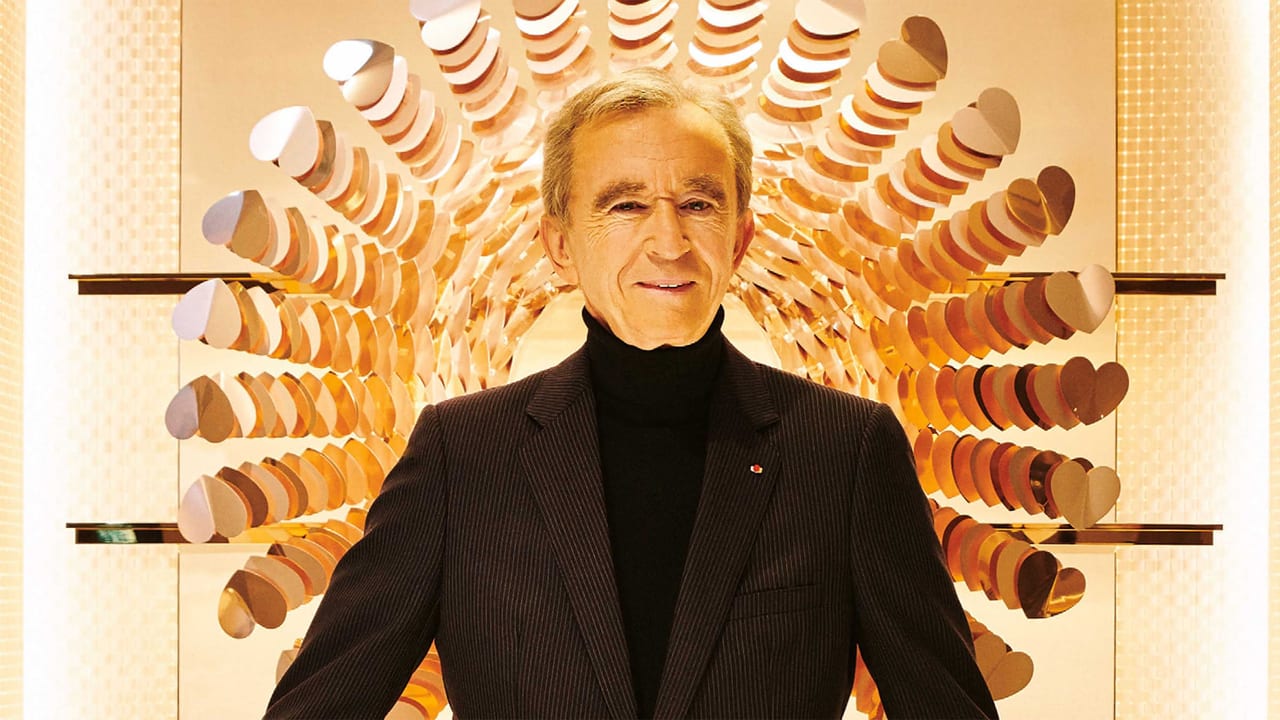
In 1984, a 35-year-old French engineer bought a bankrupt textile company for a symbolic one franc. Four decades later, that company’s descendant — LVMH — is worth over €300 billion.
Before Bernard Arnault, the luxury industry was a collection of family-owned houses, many of them financially fragile, most of them resistant to the idea that fashion could be managed like a business. Dior was buried inside a failing conglomerate. Louis Vuitton and Moët Hennessy were locked in a merger neither side fully controlled. The great European Maisons had heritage and craftsmanship — but no scale, no margin discipline, and no global distribution strategy.
After Arnault, luxury became the most profitable consumer industry on earth. One group — his group — now controls 75 maisons across fashion, spirits, jewellery, watchmaking, cosmetics, and retail, employing over 213,000 people in 80 countries. Bernard Arnault didn’t just build a company. He built the operating model that the entire luxury sector now follows.
This is the strategic biography of how he did it — the specific deals, the calculated ruthlessness, and the patience that most profiles gloss over.
Who is Bernard Arnault?
Bernard Arnault is the chairman and CEO of LVMH Moët Hennessy Louis Vuitton, the world’s largest luxury goods conglomerate. As of late 2025, Forbes estimates his net worth at approximately $190 billion, a figure derived primarily from his family’s 50.01% stake in LVMH and their controlling interest in Christian Dior SE. He has repeatedly traded the title of world’s richest person with Elon Musk and Jeff Bezos since first claiming it in December 2022 — a striking milestone for a man whose fortune rests not on technology or retail logistics, but on handbags, champagne, and haute couture.
But reducing Arnault to a net worth figure misses the point. His significance lies in what he proved: that luxury, long dismissed by serious industrialists as a niche business dependent on creative genius and family patronage, could be consolidated, professionalised, and scaled into a global force. Every luxury conglomerate that exists today — Kering, Richemont, Capri Holdings — operates in the architectural framework Arnault pioneered.
The one-franc deal that started everything
Arnault’s origin story is not the tale of a fashion obsessive. He trained as an engineer at École Polytechnique, France’s most elite technical institution, and joined his father’s civil engineering firm, Ferret-Savinel, in Roubaix. In 1984, when the French government was looking to offload the bankrupt Boussac Saint-Frères textile group — then controlled by the failed Agache-Willot-Perrachon holding company — Arnault saw what others didn’t.
Boussac was a sprawling mess — nappies, textiles, department stores — haemorrhaging cash. But buried inside it was Christian Dior, still one of the most recognised names in global fashion. Arnault raised $15 million from his family and secured $45 million from Lazard Frères to acquire the entire Boussac group. He paid a symbolic one franc for the deal, then systematically sold off every asset except Dior.
It was a template he would use again and again: identify a prestigious brand trapped inside a mismanaged structure, acquire the structure cheaply, extract the brand, and invest in its creative and commercial potential. The pattern was industrial, not romantic. Arnault wasn’t saving Dior out of love for fashion. He was buying an undervalued asset with extraordinary brand equity and near-zero competition for its name.
How did Arnault seize control of LVMH?
The creation of LVMH in 1987 was not Arnault’s doing — it was a defensive merger between Louis Vuitton and Moët Hennessy, engineered partly to fend off raiders. But the merger was unstable. The two sides distrusted each other, and Henry Racamier, who ran Louis Vuitton, was locked in a power struggle with the Moët Hennessy faction.
Arnault entered as what both sides thought was a friendly investor. Using capital from Guinness (the drinks group, which had its own strategic interest in Moët Hennessy’s distribution), he began quietly accumulating LVMH shares. By 1989, he held a controlling stake. Racamier, who had invited Arnault in as an ally, found himself outmanoeuvred. The French press dubbed Arnault “the wolf in cashmere” — a characterisation he has never fully shaken and has never seemed particularly bothered by.
The hostile takeover of LVMH established a pattern that defined Arnault’s career: charm, strategic patience, and a willingness to act decisively when the moment arrived. He did not raise his voice. He raised his stake. By the time his opponents understood what was happening, it was already done. This combination of social elegance and corporate aggression is central to understanding how one man came to dominate an industry built on taste and tradition.
The acquisition playbook: Buy heritage, install talent, wait
Once in control of LVMH, Arnault embarked on three decades of acquisitions that transformed the group from a Franco-centric luxury house into a global portfolio spanning six sectors. The approach was consistent: acquire brands with deep heritage and loyal followings, install visionary creative directors, professionalise operations, and hold.
| Year | Acquisition | Sector | Strategic Significance |
|---|---|---|---|
| 1984 | Boussac (Christian Dior) | Fashion | Foundation — extracted Dior from a bankrupt conglomerate |
| 1988–89 | LVMH (controlling stake) | Multi-sector | Gained control of Louis Vuitton, Moët, Hennessy |
| 1997 | Sephora, DFS | Retail | Vertical integration — owned distribution channels |
| 2011 | Bulgari (€4.3B) | Jewellery | Major entry into high jewellery |
| 2013 | Loro Piana (€2B) | Textiles | Prestige cashmere and fine materials |
| 2021 | Tiffany & Co. ($15.8B) | Jewellery | Largest luxury acquisition in history |
The 1990s: Speed and scale
The 1990s were Arnault’s most aggressive decade. LVMH acquired Céline, Berluti, Kenzo, Loewe, Guerlain, and Marc Jacobs — each a storied house, each available at a price that reflected the industry’s undervaluation of its own assets. He also moved into retail, buying Sephora (then a mid-sized French beauty chain) and DFS (the duty-free giant), giving LVMH direct control of distribution channels that competitors relied on third parties to manage.
The hiring of Marc Jacobs at Louis Vuitton in 1997 signalled something new: Arnault understood that creative directors were not interchangeable employees but strategic assets who could redefine a brand’s cultural relevance. Jacobs transformed Louis Vuitton from a luggage company into a fashion powerhouse, and Arnault gave him the freedom to do it. The lesson — creative autonomy within financial discipline — became the LVMH management philosophy.
The 2010s: Jewellery and consolidation
By 2010, LVMH’s fashion and spirits portfolio was largely built. Arnault turned to sectors where the group was underweight. The €4.3 billion acquisition of Bulgari in 2011 gave LVMH a major position in high jewellery. The €2 billion purchase of an 80% stake in Loro Piana in 2013 — increased to 94% in January 2026 for an additional €1 billion — added the world’s most prestigious cashmere and fine textiles house. These were not turnaround stories. They were bets on brands already operating at the top of their categories, acquired to fill gaps in a portfolio designed to cover every major luxury vertical.
The Tiffany masterstroke
The $15.8 billion acquisition of Tiffany & Co. in 2021 was Arnault’s largest and most consequential deal. Tiffany gave LVMH a dominant position in the American jewellery market and a globally recognised brand with immense emotional resonance — the blue box, the Audrey Hepburn association, the engagement ring tradition. Arnault had initially agreed to pay $16.2 billion, then used the pandemic to renegotiate a lower price after Tiffany’s revenues dipped. The move was vintage Arnault: opportunistic, patient, and unapologetic. Under LVMH ownership, Alexandre Arnault (Bernard’s second son) was installed as executive vice-president, and the brand underwent a creative repositioning that has already begun to pay off.
What makes Arnault’s management style different?
Arnault runs LVMH with a paradox at its core: radical decentralisation of creative decisions combined with rigid centralisation of financial control. Each maison has its own creative director, its own identity, and significant autonomy over product design and brand expression. But financial reporting, supply chain management, real estate strategy, and capital allocation all flow through Paris.
The result is a structure where brands compete internally for resources and attention — a deliberate strategy. Arnault has said publicly that internal competition keeps the maisons sharp. He reviews the performance of each house personally, and creative directors who fail to deliver commercially do not last long, regardless of their critical acclaim. John Galliano’s tenure at Dior — creatively spectacular, commercially transformative, ultimately ended by personal scandal — illustrates both the upside and the risk of the Arnault model: he bets on outsized creative talent, gives them room, and expects results.
This management approach has produced a group with operating margins that routinely exceed 25% in its fashion and leather goods division — a figure that would be remarkable in technology, let alone in an industry that depends on hand-stitched leather and artisanal craftsmanship. According to LVMH’s 2024 annual results, the group generated €84.7 billion in revenue, with recurring profit of €19.6 billion. Those numbers reflect a machine built for consistency, not just creativity.
Beyond business: The art collector and cultural patron
Arnault’s influence extends well beyond balance sheets. The Fondation Louis Vuitton, designed by Frank Gehry and opened in Paris’s Bois de Boulogne in 2014, is one of the most architecturally significant museums built this century. Its twelve glass “sails” house Arnault’s personal art collection — works by Gerhard Richter, Jeff Koons, Jean-Michel Basquiat, and Giacometti — alongside rotating exhibitions that have drawn millions of visitors.
The foundation is not philanthropy in the conventional sense. It is brand architecture at the highest level — a physical manifestation of the idea that LVMH and its chairman sit at the intersection of commerce and culture. The building itself cost an estimated €780 million, more than double the original budget, and Arnault approved every overage. When you control a €300 billion empire built on the perception of taste, a museum of that calibre is not an indulgence. It is infrastructure.
The succession question: Five children, one throne
The most consequential chapter of the Arnault story is still being written. Bernard Arnault is 75, and all five of his children now hold senior positions within the LVMH ecosystem. Delphine Arnault, 48, is president and CEO of Christian Dior Couture. Antoine Arnault, 46, serves as chairman and CEO of Christian Dior SE and oversees LVMH’s communications. Alexandre Arnault leads Tiffany & Co. as executive vice-president. Frédéric Arnault, the youngest at 29, is CEO of LVMH Watches. Jean Arnault, 26, heads watchmaking marketing at Louis Vuitton.
In 2023, the Arnault family restructured their holding company, Financière Agache, transferring 75% of bare ownership to the five children and two cousins (sons of Arnault’s late sister Dominique). The family now controls 50.01% of LVMH’s capital and 65.94% of voting rights. This is not a vague succession plan — it is a legal architecture designed to keep the group under family control for at least the next 30 years, insulated from the kind of hostile takeover that Arnault himself once executed.
Who will actually run the group remains an open question. Arnault has publicly stated that he has not chosen a successor, and the quiet competition among the Arnault children now positioning to succeed him is the luxury industry’s most closely watched corporate drama — a real-life version of the television series that borrowed its dynamics from families exactly like this one.
The Arnault blueprint and what it means for luxury
Bernard Arnault’s legacy is not sentimental. He did not save the luxury industry out of cultural devotion. He saw fragmented, undercapitalised businesses sitting on brand equity worth multiples of their market valuations, and he spent four decades systematically acquiring them. The result is the complete LVMH brand portfolio he assembled — 75 maisons generating nearly €85 billion in annual revenue, a group so dominant that its nearest competitor, Kering, generates less than a quarter of its sales.
What Arnault understood — and what made him the most consequential figure in modern luxury — is that heritage brands are not static assets. They are compounding machines. A brand like Louis Vuitton or Dior, properly managed, becomes more valuable with every decade that passes. The name accumulates cultural weight. The customer base inherits its loyalty generationally. The margins improve as scale drives down production costs while prices rise with perceived exclusivity. This is the Arnault insight, and it is why he has never sold a major brand once acquired.
Whether the empire he built can sustain itself beyond his direct oversight is the question that will define the next era of luxury. His children are positioned. His legal structures are in place. But LVMH’s greatest asset has always been the strategic judgement of one man — and that, by definition, is not transferable.
To understand where Arnault sits among today’s most powerful figures in the sector, explore the luxury power list he perennially tops. For a closer look at the executives behind the LVMH maisons, see LVMH’s leaders on Worthbury — or browse the full directory of luxury professionals.