Who Owns Hermès? The Family Dynasty Behind Luxury's Most Exclusive Maison
Six generations, one vision. How the Hermès family built, defended, and still controls the world's most exclusive luxury Maison.
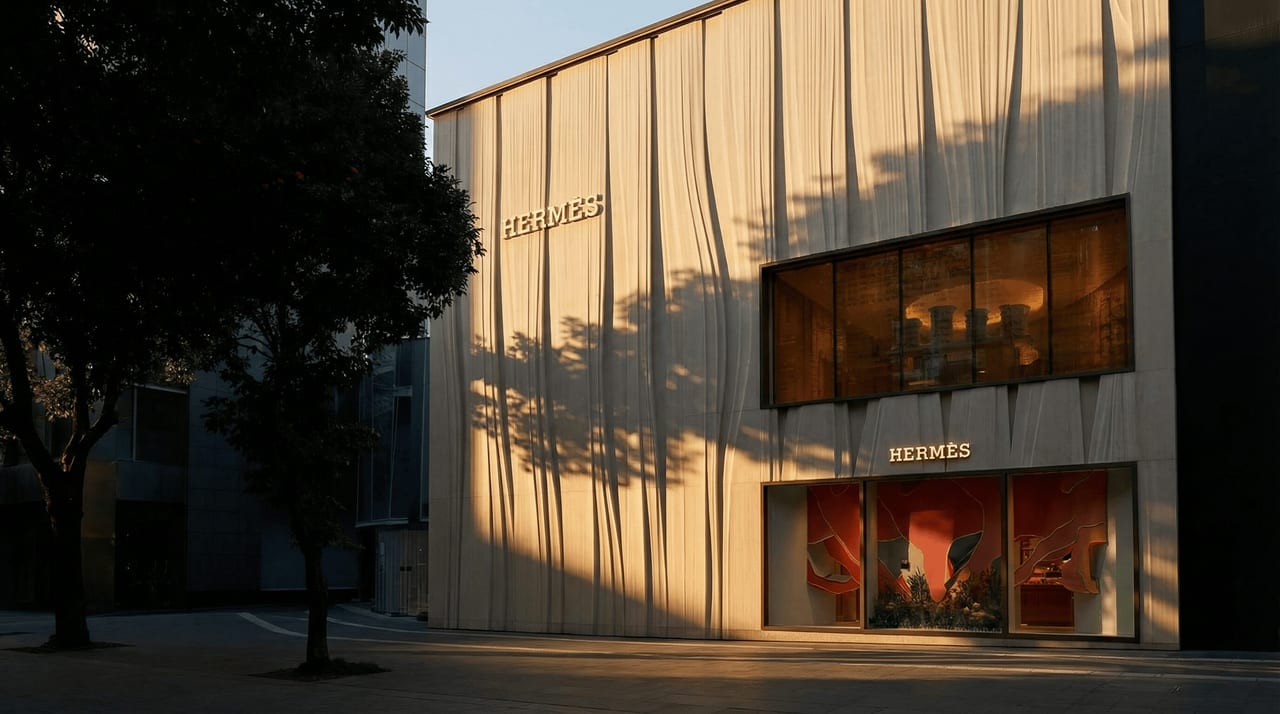
A saddlery workshop founded in 1837 is now worth more than LVMH’s entire empire. And the same family still runs it.
In April 2025, Hermès International briefly surpassed LVMH to become the world’s most valuable luxury company — a market capitalisation exceeding €243 billion. The twist: Hermès employs a fraction of LVMH’s workforce, operates a fraction of its brands, and has never once been controlled by anyone outside the founding family. Six generations, nearly 190 years, zero change in ownership philosophy.
So who owns Hermès? The short answer is the Hermès family — descendants of Thierry Hermès, the harness-maker who opened a workshop on the Rue Basse-du-Rempart in Paris. The longer answer involves a dynasty that fought off the richest man in luxury, structured one of the most resilient governance models in corporate history, and still produces the world’s most coveted leather goods by hand.
This is that story.
Who owns Hermès today?
Hermès International S.A. is publicly listed on the Euronext Paris exchange, but make no mistake — this is a family-controlled company. The Hermès family collectively holds approximately 66.7% of the company’s share capital and more than 76% of its voting rights, giving them decisive control over every strategic decision. The primary vehicle for this control is H51 SAS, a holding company created in December 2010 that pools the shares of 52 key family members drawn from three main branches: the Dumas, Guerrand, and Puech lines.
H51 itself holds roughly 50.2% of Hermès’ capital. The remaining family shares are held through smaller individual and family trusts, bringing the total well above the two-thirds threshold. A 20-year lock-up agreement prevents H51 members from selling their shares on the open market — a deliberate design to ensure no external buyer can accumulate a controlling position.
The executive leadership reflects this family grip. Axel Dumas, a sixth-generation descendant, serves as Executive Chairman. His cousin Pierre-Alexis Dumas holds the role of Artistic Director, overseeing the creative vision that runs through every product the Maison produces. Between them, the two Dumas cousins represent both the commercial and creative pillars of the house — a dual structure the family has maintained in various forms for over a century.
From saddlery to silk: How the Hermès dynasty began
Thierry Hermès was a harness-maker, not a fashion designer. When he established his workshop in 1837, his clients were coachmen, cavalry officers, and the European aristocracy’s stable masters. His harnesses were prized for their durability and quiet refinement — a combination that earned a first-class medal at the Universal Exhibition of 1867 in Paris.
His son, Charles-Émile Hermès, made the pivotal decision that would define the family’s trajectory. In 1880, he relocated the workshop to 24 Faubourg Saint-Honoré — the address that remains Hermès’ spiritual headquarters to this day. Charles-Émile expanded beyond harnesses into retail, selling saddles and equestrian accessories directly to a wealthy clientele. The carriage trade, as it was known, became the foundation of the Hermès identity: craftsmanship built for function, finished to the standards of art.
The third generation brought the most radical pivot. Émile-Maurice Hermès, Charles-Émile’s son, saw the automobile replacing the horse and understood that the family business needed to evolve or die. Rather than abandoning leather craft, he applied the same saddlery techniques to a new category: travel goods, handbags, and personal accessories. The Haut à Courroies bag — originally designed to carry saddles — became the ancestor of every Hermès bag that followed. In 1937, to mark the Maison’s centenary, Hermès introduced the first silk scarves, printed using a meticulous layering process that required a separate screen for each colour.
Who were the key figures in Hermès’ six generations?
Each generation of the Hermès family redefined the Maison without abandoning its core principle: artisanship above all.
| Generation | Key Figure | Era | Defining Contribution |
|---|---|---|---|
| 1st | Thierry Hermès | 1837–1878 | Founded the workshop; established the craft of fine harness-making |
| 2nd | Charles-Émile Hermès | 1878–1922 | Moved to 24 Faubourg Saint-Honoré; launched retail sales |
| 3rd | Émile-Maurice Hermès | 1922–1951 | Pivoted from saddlery to leather goods, handbags, and silk scarves |
| 4th | Robert Dumas | 1951–1978 | Cemented Hermès’ position in high fashion |
| 5th | Jean-Louis Dumas | 1978–2006 | Global expansion; created the Birkin bag; built the industry’s highest margins |
| 6th | Axel Dumas & Pierre-Alexis Dumas | 2013–present | Defended family control; sustained 41% operating margins |
The fourth generation introduced the Dumas branch. Robert Dumas, Émile-Maurice’s son-in-law, led the company through the mid-twentieth century and is credited with cementing the Maison’s position in high fashion. His son, Jean-Louis Dumas, became perhaps the most transformative leader in Hermès history. Taking the helm in 1978, Jean-Louis expanded the brand globally, opened new product categories, and — most famously — created the Birkin bag in 1984 after a chance encounter with actress Jane Birkin on a Paris-to-London flight. The Kelly bag, originally launched in 1935 as the Sac à dépêches, had already achieved iconic status after Grace Kelly was photographed carrying one in 1956.
Jean-Louis Dumas understood something that most luxury executives still struggle with: scarcity is not a limitation, it is the product. Under his leadership, Hermès refused to mass-produce, refused to discount, and refused to chase trends. Revenue grew steadily. Margins grew faster. By the time he stepped down in 2006, Hermès had become the industry’s most profitable Maison — a position it has never relinquished.
The current generation — Axel Dumas and Pierre-Alexis Dumas — represents the sixth. Axel, who became CEO in 2013, has continued the family’s discipline of controlled growth: revenue increases of 6–7% per year, no licensing deals, no diffusion lines, no compromise. Under his leadership, Hermès posted revenue of approximately €16 billion and an operating margin of 41% in 2025 — the highest in the luxury sector.
The LVMH Siege: How Hermès fought off Bernard Arnault
The defining test of the Hermès family’s unity came not from the market, but from Bernard Arnault himself. Beginning around 2001, LVMH quietly accumulated Hermès shares through equity swaps — financial instruments that allowed Arnault’s team to build a position without triggering the mandatory disclosure threshold of 5%. The strategy was invisible to the public and, critically, to the Hermès family.
In October 2010, Arnault placed a phone call to Patrick Thomas, the first non-family CEO in Hermès history. The message was brief: LVMH had acquired a 17% stake and intended to buy more. The announcement would hit the press within two hours. Thomas was cycling through the French countryside when he received the call. By the time he returned to Paris, the luxury world’s most audacious corporate raid was public knowledge.
The Hermès family’s response was swift and coordinated. Within weeks, approximately 50 family descendants gathered to devise a defensive strategy. By December 2010, they had established H51, the holding company that pooled their shares under a single structure with strict pre-emption rights. Any family member who wished to sell their shares would first have to offer them to other H51 members — effectively creating an impenetrable wall against external accumulation. The name H51 itself references the number of founding family shareholders.
The legal battle that followed lasted years. In 2012, Hermès filed a lawsuit and French prosecutors opened an investigation into alleged market manipulation by LVMH. In 2013, France’s stock market authority (AMF) ruled that LVMH had indeed built its stake through deceptive means — not as a passive financial investment, as Arnault had claimed, but as a deliberate acquisition strategy. LVMH was fined €8 million. In 2014, under a court-mediated agreement, LVMH relinquished its entire Hermès stake — then worth approximately €7.5 billion — by distributing shares to its own shareholders, and agreed not to purchase Hermès stock for five years.
The episode became a case study in family governance. It also made the Hermès family significantly richer: the defensive consolidation locked in their collective position at precisely the moment before a decade of extraordinary share price appreciation.
Why does the Hermès model produce the industry’s highest margins?
Hermès’ operating margin of 41% is not a fluke — it is a structural outcome of family control. Because the Hermès family answers to no external shareholder demanding quarterly growth, they can make decisions that publicly traded competitors cannot: limiting production to maintain scarcity, investing in multi-year artisan training programmes, refusing to enter lower-margin product categories, and pricing without reference to competitors. Every Birkin bag is still hand-stitched by a single artisan over 18 to 24 hours. The Maison employs more than 6,800 craftspeople across its workshops in France, and has been opening new ateliers — not closing them — to meet demand without compromising quality.
This model inverts the logic of most luxury conglomerates. Where LVMH grows by acquiring brands and scaling them, Hermès grows by deepening a single brand’s desirability — a philosophy explored in depth in our analysis of the strategy behind Hermès’ legendary exclusivity. Where Kering restructures portfolios, Hermès restructures nothing. The family’s H51 holding company, with its 20-year lock-up and pre-emption rights, ensures that short-term thinking never enters the boardroom. Axel Dumas has stated publicly that the company plans in generations, not quarters.
The result: Hermès’ share price has increased more than tenfold over the past decade. The family’s collective fortune was estimated at €177 billion by French business publication Challenges in 2025. For a company that started as a harness workshop, that is a return on patience that no private equity model can replicate.
Hermès and the last independent Maisons
Hermès is not the only family-controlled luxury house — but it is the most valuable by a wide margin. Chanel, the other fiercely independent luxury house, remains entirely private under the Wertheimer family, meaning its exact valuation is opaque. Rolex operates under the Hans Wilsdorf Foundation. But neither Chanel nor Rolex is publicly listed, which makes Hermès unique: a company that invites the scrutiny of public markets while operating with the long-term discipline of a private family enterprise.
This combination — public transparency, private-family governance — is the structural moat that competitors find impossible to replicate. A publicly listed company faces pressure to grow fast; a family company can afford to grow slowly. Hermès does both, on its own terms. The 52 shareholders of H51 have committed to holding their shares for 20 years. The artisans in the ateliers commit to years of training before they produce a single finished good. The customers commit to waiting lists that can stretch years for a Birkin or Kelly. At every level, the Hermès model is built on patience — and patience, in luxury, is the rarest asset of all.
What comes next for the Hermès dynasty?
The question is not whether Hermès will remain family-controlled — the H51 structure ensures that for at least another decade. The question is whether the seventh generation can maintain the same balance of creative integrity and commercial discipline that has defined every transition before them. History suggests they can. Each generation has faced a moment of existential reinvention — the shift from horses to automobiles, from saddlery to fashion, from French house to global brand, from private company to public market — and each time, the family adapted without abandoning the founding principle: make the finest goods, by hand, without compromise.
The Hermès family’s story is not just a corporate history. It is a masterclass in what happens when ownership, craft, and patience align over nearly two centuries — and when a family says no to the most powerful man in luxury, and is proven right.
To see who leads Hermès today, meet the Hermès leaders on Worthbury.