
Brunello Cucinelli opens Casa Cucinelli flagship in historic Shanghai residence
The three-floor space in Cao Zhai pairs a library of Western and Chinese classics with Sartoria Solomeo tailoring.


Brunello Cucinelli has opened Casa Cucinelli in Shanghai, its new flag in the Asian market, housed in the Cao Zhai residence. The historic building dates back to 1927 and was originally designed by the architect Gu Daosheng. It is part of the China Resources Centre in the city's Jing'an district.
The Italian house, founded in 1978 and known for its cashmere and upscale knitwear, has chosen not to treat the address as a conventional boutique. Cucinelli's team describes it as a place for encounter and conviviality, layering Italian hospitality over local residential traditions and a series of interconnecting rooms.
The renovation pushed the original structure outward. One façade has been absorbed into a new winter garden, a sheltered courtyard that draws openly on Shanghai's traditional Shikumen architecture. Conservation work kept the floor mosaics, fine parquet, stained-glass windows, stucco ceilings, fireplaces and a monumental Art Deco staircase.
The layout is organised around the geometry of the square, a shape Eastern culture ties to earth, stability, order and balance. Botticino marble pairs with wooden floors, clay, jute and brass accents, while glass and bronzed mirrors face beige linen, cotton and leathers in dark earth and light stone tones.
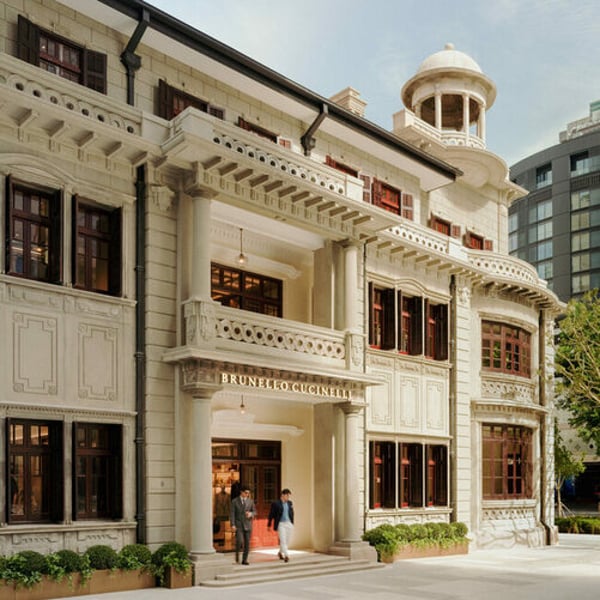
Spread over three levels, the building places its living heart on the ground floor rather than the merchandise. Beyond the entrance hall, where busts of Ibn Khaldoun and Confucius stand beside classical capitals, visitors meet a large library holding more than 500 volumes that joins masterpieces of Western thought with curated Chinese classics.
A second account puts the library at more than 1,000 Chinese and Western classics. Either way, the ground floor is built for reading, dining and conversation: a café with a carved wooden fireplace, a dining room merging Italian food with local culinary tradition, a second bar and several private lounges for discreet talk.
Collections and bespoke services
The upper floors hold the house's collections. The first floor is given entirely to women's ready-to-wear and accessories, the second to menswear, although one report places the men's collection on the third floor. The store debuts two exclusive bespoke services: Sartoria Solomeo for men and Solomeo Atelier for women.
Sartoria Solomeo offers made-to-measure through direct consultation with master tailors, while Solomeo Atelier handles private events and personalised journeys led by the women's creative team. At the very top, a domed pavilion alters the skyline and gives guests a panoramic view over Shanghai.
The sense of home extends to the building itself. Cucinelli sought to preserve as much of Cao Zhai's original structure and character as possible, down to its original doors and windows. The result, the house says, is a place people can walk into naturally, with the ease of visiting a friend's home.
A film, a village, a strategy
At the Shanghai Film Art Center the house hosted a gala around Brunello: The Gracious Visionary, a biographical film tracing the founder's life from the Italian countryside to the international fashion stage. It was directed by Giuseppe Tornatore, who also made Cinema Paradiso, The Legend of 1900 and Malèna.
The film combines archival footage, interviews and dramatised reenactments to follow the entrepreneur long known as the King of Cashmere. Its ideas trace back to Solomeo, the Italian village where the company is headquartered, and where the founder has for years restored historic buildings, preserved crafts and supported the arts.
When we covered the house's nine-month results, China, North America and retail were doing the heavy lifting behind sales that passed €1.12 billion, and the company lifted its 2026 outlook to 12% growth. The Shanghai flagship gives that Chinese momentum a physical home.
As affluent consumers place more value on the cultural meaning and emotional experience behind what they buy, the house is spending on spaces and personal storytelling rather than chasing short-term attention alone.
The two openings point to a long-term Chinese strategy built on culture and identity rather than product alone. The aim is to move Chinese consumers from appreciating the products toward sharing the values behind them, using the residence, the film and the founder's own story.
Rather than recreating an Italian lifestyle in Shanghai, Cucinelli took a building steeped in the city's own history, bringing Italian hospitality into conversation with the local Shikumen tradition. CJ Fashion in São Paulo, which we covered, carries the brand among roughly 150 labels, but this is a house of its own.
Casa Cucinelli is pitched as more than a place to display and sell clothes: an open door to Chinese friends of the brand. Cucinelli says visitors should find it neither intimidating nor distant despite its luxury status.
Support the content you love — it’s free 🎉
Add Worthbury as a preferred source on Google. Our stories will be more likely to appear in Google’s Top Stories. It’s free and supports our team. Thank you!
Add as preferred sourceYou can remove us any time in Google’s source preferences.
Thank you — you’re all set 🎉
Worthbury is now one of your preferred sources, so our briefings are more likely to appear in Google’s Top Stories.
Sources
This briefing is published daily using an AI-powered system crafted by Worthbury's team and finely tuned to meet our editorial standards. While we continuously test and review the output, mistakes can sometimes happen. Tell us if you spot one.
Images: Brunello Cucinelli; FashionNetwork