
Jacob Cohën opens first US store on Madison Avenue
The 3,121-square-foot corner flagship opens October 27, with women's on the ground floor and a "gentleman's club" upstairs.


Jacob Cohën is opening its first United States store at 790 Madison Avenue on 67th Street, a 3,121-square-foot corner flagship inside a 1960s modernist building. The Milan-based label, best known for premium denim, will officially open the doors on October 27.
The store carries six large windows on the ground floor and six more on the second level, twelve in total. Women's collections are on the entry floor while men's have the upper level, a layout owner Jennifer Tommasi Bardelle shaped directly with the Milan design practice Storage Milano.
Tommasi Bardelle is the widow of Nicola Bardelle, who revived the dormant family denim name in 2002 with a plan to make luxury jeans for men. He launched the label's women's models soon after, building each pair from noble fabrics such as Japanese Kurabo and finishing them with jeweled buttons and hand-embroidery.
The brand itself dates to 1985, when Nicola's father Tato Bardelle founded it and named it after Jacob Davis, the inventor of the rivet. The Cohen half was added to honour the Jewish heritage of Levi Strauss and to separate the premium line from the family's other business, which had made the Americanino jean.
The family lost everything in the 1990s and the name went dormant, Tommasi Bardelle said, until Nicola revived it. He was killed in August 2012 in a motorcycle accident in Saint-Tropez, where Jacob Cohën had just opened its first store, leaving his wife and two small children in control of the vision.
Tommasi Bardelle described the brand as "our third child." Regaining the license took years and, she said, a dozen lawsuits, which were resolved in 2023. That cleared the way for her to elevate Luca Roda, a longtime supporter of the company, to chief executive officer.
Inside the Madison Avenue flagship
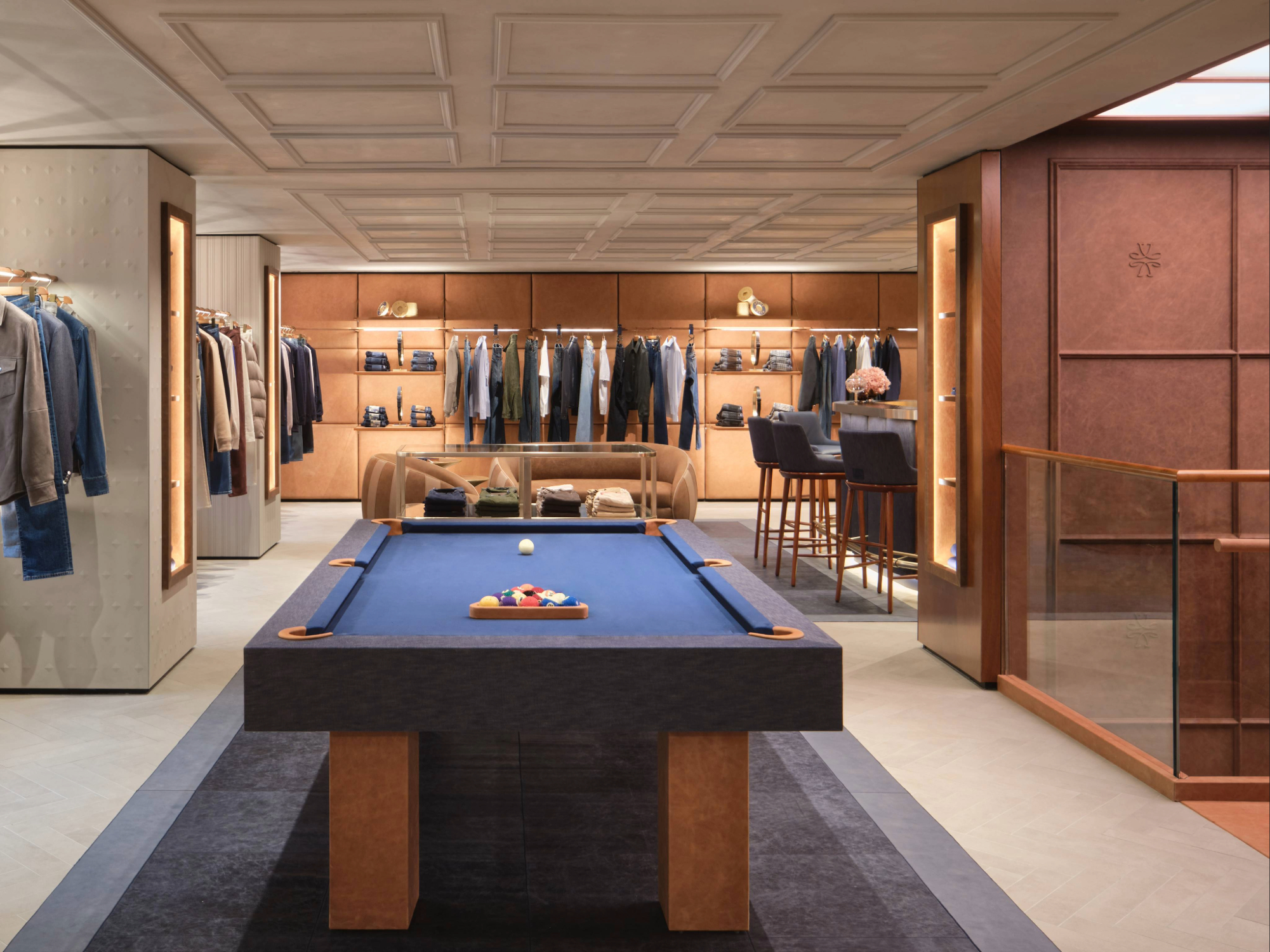
The interior was conceived as a physical expression of the brand, built from denim, leather, wood, metal and minerals. Walls and ceilings carry hand-applied cement-based plaster, the same material used for the moldings, while the floor runs to grey klinker tiles laid in a herringbone pattern.
Leather is everywhere: on walls, displays, upholstered surfaces and the staircase, whose handcrafted wood moldings were covered by hand in leather beneath a backlit skylight. The staircase alone took a month and a half to complete, pushing back the opening date, and selected wall panels carry the Jacob Cohën monogram worked in leather.
Denim, the foundation of the brand, appears on upholstered wall panels, with a vertical rail system between them allowing shelves and hanging bars to be repositioned. Light and dark leather and denim are beside rotary-cut okoumé wood that has been sanded, stained and finished with shellac.
In front of the windows stand articulated steel screens in a brushed light-gold finish. The second floor, which Tommasi Bardelle called a "gentleman's club," holds a bar finished in denim and wood, backed by textured orange glass, plus a pool table made by a 150-year-old Naples firm and furnishings created with Asnaghi.
The bar serves a special barley cappuccino she discovered at a European spa, the same drink poured at the label's Milan store. Fitting rooms for both sexes are small self-contained spaces with ribbed velvet walls in beige and blue, one women's room carrying custom wallpaper developed specifically for New York.
The velvet walls will need combing several times a day, Tommasi Bardelle said. A lower level closed to the public holds a kitchen, office and storage. The brand's signature fragrance is diffused through the store, and the company aims for spaces people come together in before they shop.
A challenge on denim's home turf
The merchandise remains front and centre. Each pair of jeans carries a distinct patch and buttons, with individualized linings, and every men's pair ships with a matching bandana, details changed seasonally. Washing instructions are printed inside and labels are cut from high-end Japanese paper.
Most jeans retail at around $500, with limited-edition models selling for more. Beyond denim, the collection spans outerwear, sweaters, trousers, blazers, knitwear and T-shirts. "Denim is still at our core, but how many jeans can people have," Tommasi Bardelle said.
She chose New York because it is the state where she was born and because there is, in her words, "lots of potential" to grow the brand's stateside reach. "It's a statement," she said, calling the opening a major milestone and a challenge embraced in what she described as the home market of denim.
Jacob Cohën already runs stores in Paris, Saint-Tropez and Nice; Milan, Rome, Forte dei Marmi and Taormina; Geneva; Puerto Banús and Palma de Mallorca; Antwerp and Knokke; Prague; Oslo; and Tokyo Midtown, Ginza and Osaka. The wholesale business includes Bergdorf Goodman, Neiman Marcus, Harry Rosen and Holt Renfrew.
Tommasi Bardelle said the goal is to grow "step by step," and that rather than open a US showroom the store will serve that role. "This is my business card," she said, adding that she would like to add units in Miami, Palm Beach and Aspen in the future.
Support the content you love — it’s free 🎉
Add Worthbury as a preferred source on Google. Our stories will be more likely to appear in Google’s Top Stories. It’s free and supports our team. Thank you!
Add as preferred sourceYou can remove us any time in Google’s source preferences.
Thank you — you’re all set 🎉
Worthbury is now one of your preferred sources, so our briefings are more likely to appear in Google’s Top Stories.
This briefing is published daily using an AI-powered system crafted by Worthbury's team and finely tuned to meet our editorial standards. While we continuously test and review the output, mistakes can sometimes happen. Tell us if you spot one.
Images: Jacob Cohën