
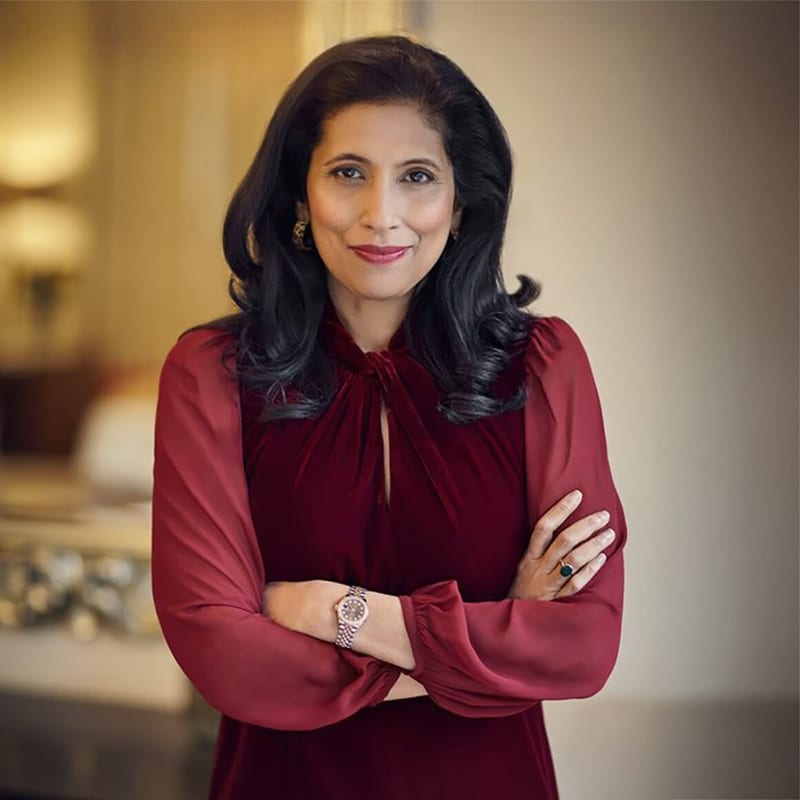
British Fashion Council names Pavita Cooper as next chair, succeeding David Pemsel
Caroline Issa, fashion director at Tank magazine, moves into a newly created deputy chair role alongside her.


Pavita Cooper has been named the next chair of the British Fashion Council, the organisation behind London Fashion Week and the Fashion Awards. She takes up the role on 1 October, succeeding David Pemsel, who steps down on 30 September after ten years on the executive board, four of them as chair.
The appointment was ratified by the BFC Executive Board on 25 August, following a search led by a nominations committee and conducted pro bono by the MBS Group. Pemsel's exit had been long planned, giving the organisation months to run the process before confirming his successor.
Cooper is a boardroom operator whose career spans business, government and culture. She has held senior executive positions at Lloyds Banking Group and Christie's, is on the boards of The King's Trust and The Old Vic, and chairs the 30 Percent Club, a campaign to increase the number of women in senior corporate leadership.

What the reshuffle adds
Alongside Cooper's appointment, current board member Caroline Issa takes on a newly created role of deputy chair. Issa is fashion director at Tank magazine and is known for close ties to designers and brands in Britain and beyond, a connection the BFC wants closer to its leadership.
Chief executive Laura Weir said Issa will help keep the board connected to the day-to-day realities of the designer community, the constituency the BFC exists to serve. Weir framed Cooper's experience of government and policy as an important complement to the board as it works to deliver its strategy.
That strategy is BFC 2030: Access, Creativity, Growth, a four-year plan set out by Weir. It aims to strengthen the BFC's influence with UK government and policymakers, expand its fundraising capabilities, and position fashion more clearly as a contributor to economic growth and cultural soft power.
The plan carries a specific financial target: growing the BFC's gross annual revenue by 38% to eighteen million pounds by 2030. Cooper's political and boardroom background is being positioned as the asset that helps close that gap over the coming four years.
Cooper described the appointment as an honour and set out her own priority for the role. "My priority will be to champion fashion as an important driver of UK growth and help strengthen the environment in which British designers, entrepreneurs and businesses can start, scale and compete globally," she said.
What the board now looks like
Pemsel described the reshaped executive board as a deliberate mix of policy, finance, creative and commercial expertise built to deliver the BFC 2030 vision. Its executive directors are Weir and Laura Strain, the organisation's chief operating officer, who between them run the council's day-to-day operations and finances.
The non-executive line-up now numbers nine: Cooper, Issa, Ciara Byrne, the designer Clare Waight Keller, Jamie Gill, Karen Blackett, Kate Varah, Scott Morrison and Sian Westerman, a group spanning designers, media figures and finance and policy specialists across British fashion.
Pemsel framed Cooper's arrival as a direct answer to the organisation's stated needs. "The appointment of Cooper as chair directly delivers on the need to supercharge the organisation's ability to engage with government and support the industry with its policy work and access to investment," he said.
The handover marks a genuine changing of the guard at the top of British fashion's governing body, coming just a day before Pemsel's own decade on the board ends. His four years as chair oversaw an organisation the announcement does not detail beyond its current strategy and revenue goals.
What the appointment leaves unaddressed is how quickly Cooper's government and policy contacts translate into the fundraising the 2030 plan requires. The BFC has set the revenue target but has not said what proportion of that growth it expects from public funding versus private sponsorship or ticket revenue.
Cooper and Issa both formally join their new roles on the same date Pemsel departs, giving the board a single clean handover rather than a staggered transition. No source has indicated any further changes to the board's composition are planned before the 2030 deadline arrives.
The succession sits alongside other leadership changes across fashion and luxury boards this year, from Richemont naming Anton Rupert co-deputy chairman to Poltrona Frau appointing Giovanni Baldi, formerly of Dolce & Gabbana, as chief executive. Each reflects boards recruiting outside specialists to steer strategy through a difficult trading period.
Support the content you love — it’s free 🎉
Add Worthbury as a preferred source on Google. Our stories will be more likely to appear in Google’s Top Stories. It’s free and supports our team. Thank you!
Add as preferred sourceYou can remove us any time in Google’s source preferences.
Thank you — you’re all set 🎉
Worthbury is now one of your preferred sources, so our briefings are more likely to appear in Google’s Top Stories.
Sources
This briefing is published daily using an AI-powered system crafted by Worthbury's team and finely tuned to meet our editorial standards. While we continuously test and review the output, mistakes can sometimes happen. Tell us if you spot one.
Images: British Fashion Council