
Coach footwear revenue grew over 20% in Q1 as Tapestry beats forecasts
Footwear contributed about 6% of Coach's overall growth as the Margot family and sneakers led the category.


Coach's footwear revenue grew over 20% in its first quarter, and Tapestry chief executive Joanne Crevoiserat told analysts on Thursday's earnings call that the category remains a "significant growth opportunity" for the brand. The Margot family of shoes and what she called the "continued success of sneakers" drove most of it.
Todd Kahn, brand president and chief executive of Coach, put a finer point on the number. Footwear contributed about 6% of Coach's overall growth in the quarter. "I mean, we're still walking," Kahn said. "We haven't run yet. There is so much opportunity."
Kahn framed the category as a working example of the brand's "One Coach" strategy, which dissolves the old division between its full-price and outlet businesses. Coach now sells some collection merchandise at full price across outlet stores for a more consistent presentation across physical and digital channels.
The Soho sneaker is the clearest test of that idea. "We launched our Soho sneaker at one price across all channels, and that's resonating," Kahn said. He called the shoe an acquisition vehicle for young men, whose first Coach purchase is often a Soho before they move into leather goods.
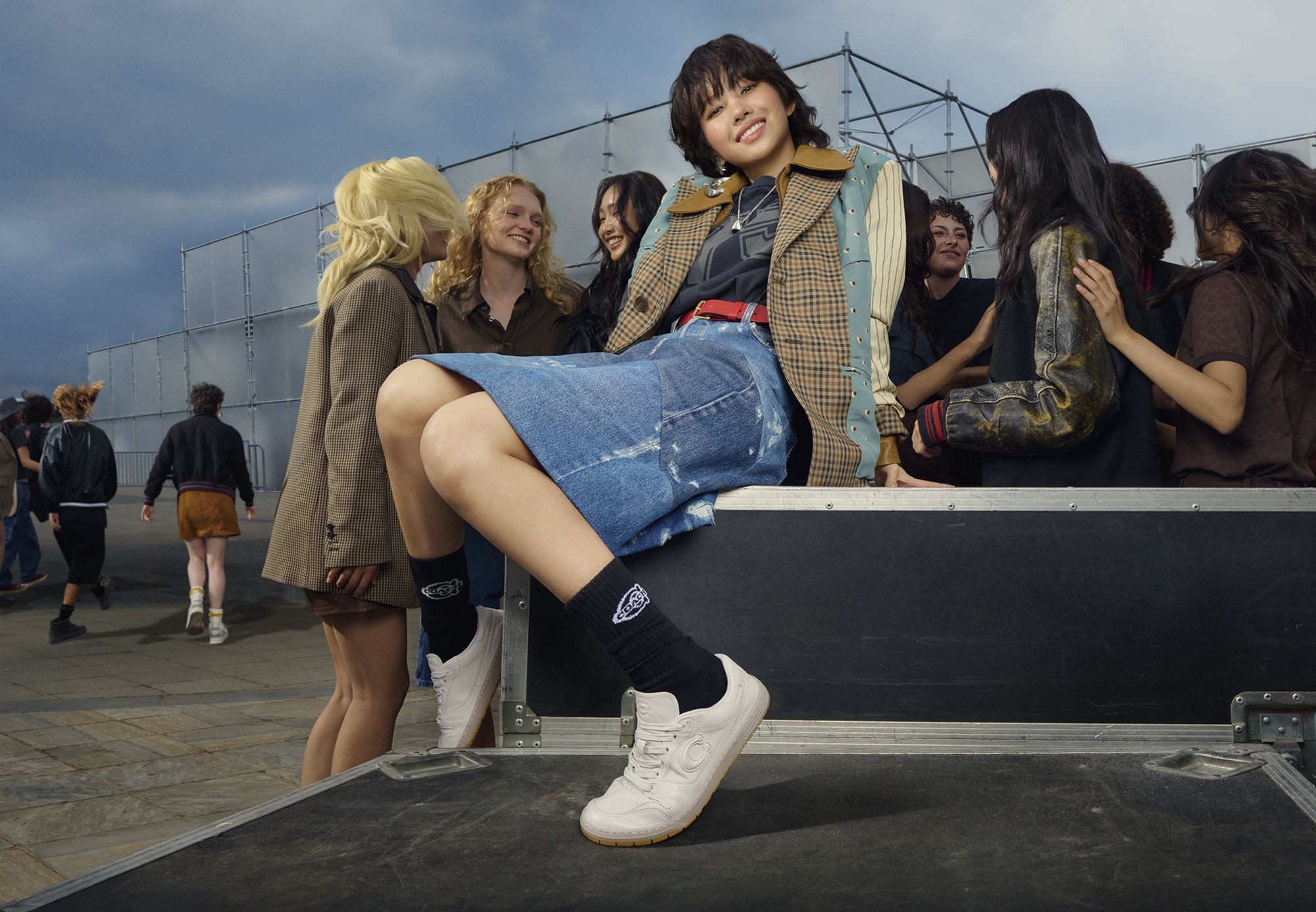
Kahn also echoed Crevoiserat's callout of the Margot collection, describing it as an "outstanding" shoe in the women's business. He said footwear adds units per transaction across direct businesses and functions as a beachhead for wholesale accounts in markets where Coach was underpenetrated, naming Europe.
"You see us drive a lot of wholesale business through that category in a very profitable way," Kahn said. The appeal is threefold, in his telling: the frequency of purchase, the additional units per transaction, and expansion across all genders.
The footwear momentum arrived inside a quarter where the parent company cleared every bar Wall Street set. Tapestry's net income for the first quarter of fiscal 2027 rose 30.9% to $360 million, or $1.76 a diluted share.
Adjusted earnings tallied $1.82 per share, comfortably above the $1.56 analysts had forecast. Sales rose 12% to $1.9 billion once Stuart Weitzman, spun off to Caleres last year, is left out of the comparison. That too came in ahead of the $1.85 billion consensus.
Direct-to-consumer sales rose 9%, while the internationally skewed wholesale business jumped 30%, three times as fast. Coach sales themselves climbed 16% to $1.7 billion. Kate Spade, which is retrenching to rebuild from a stronger base, fell 10% to $233 million for the quarter.
We noted earlier this quarter that Coach was again the engine carrying the group, and the split here underlines it: a 16% rise at Coach against a double-digit decline at Kate Spade. Our coverage of Tapestry beating forecasts on Coach's growth and a climbing outlook now gains a footwear thread.
The "One Coach" strategy behind the sneaker push is the same repositioning we have tracked as it drove Tapestry past an $8 billion annual revenue target a year early. Footwear is the newest proof that the handbag turnaround can extend beyond bags.
Our map of the second-tier luxury conglomerates positions Tapestry as a group whose reliance on Coach shows the risk of owning brands without a balanced portfolio. A surging Coach footwear category deepens that concentration rather than relieving it, even as it widens the brand itself.
Looking ahead, Tapestry nudged its full-year outlook upward. Revenues are now expected to rise 6% to 7%, to a range of $8.5 billion to $8.6 billion, moving the top of guidance up $100 million from the initial forecast.
What footwear adds to the brand
Kahn's account of footwear as a wholesale beachhead matters because of where the growth is. Wholesale is the internationally skewed part of the business, and footwear is the product carrying Coach into new accounts, with Europe the market he named as underpenetrated.
The category's appeal also rests on repeat purchase. An accessory that customers buy often, adds to a basket, and works across genders is cheaper for Coach to grow than a single leather good bought once. That is the arithmetic behind Kahn listing frequency and units per transaction first.
Soho does a second job beyond price consistency. Kahn called it an acquisition vehicle because the sneaker brings in young male customers whose first Coach item is a shoe rather than a bag. Footwear, in that telling, is the front door to the brand's leather goods business.
Crevoiserat and Kahn returned to Margot repeatedly, and the collection is the women's counterpart to the sneaker-led men's push. The two names together give Coach a footwear story spanning both sides of the business, which is why the executives describe the category as still only walking.
Support the content you love — it’s free 🎉
Add Worthbury as a preferred source on Google. Our stories will be more likely to appear in Google’s Top Stories. It’s free and supports our team. Thank you!
Add as preferred sourceYou can remove us any time in Google’s source preferences.
Thank you — you’re all set 🎉
Worthbury is now one of your preferred sources, so our briefings are more likely to appear in Google’s Top Stories.
This briefing is published daily using an AI-powered system crafted by Worthbury's team and finely tuned to meet our editorial standards. While we continuously test and review the output, mistakes can sometimes happen. Tell us if you spot one.
Images: Courtesy of Coach