
China's listed apparel makers split into winners and laggards in H1 2026
Four premium brands posted gross margins above 65% while legacy casualwear names saw profits fall even as revenue grew.


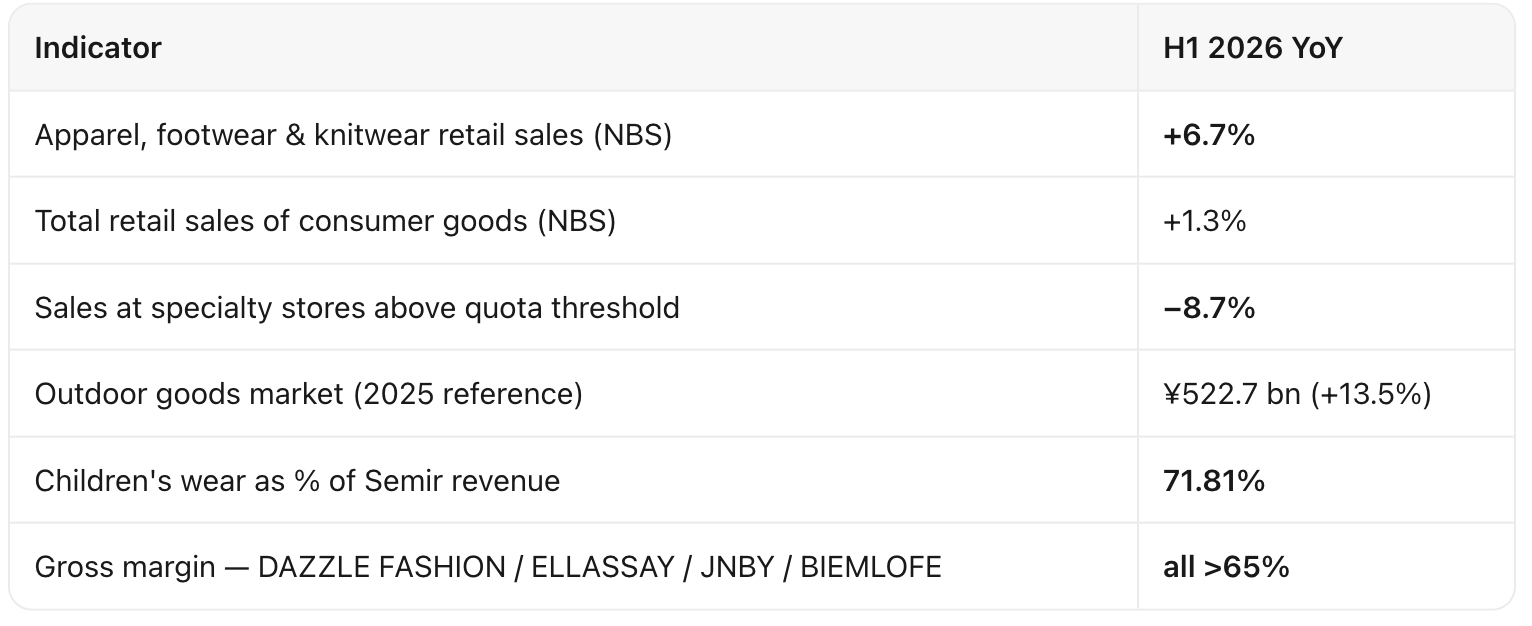
China's first-half 2026 earnings season has produced two starkly different stories from the same apparel market. Biemlofe posted revenue growth of 23.7%, with online sales up more than 100%. Balabala, the kidswear arm of Semir Group, generated 4.83 billion yuan, or $677 million, in first-half revenue.
That figure accounts for 71.8% of Semir's total revenue, up 11.9% year on year, and now dwarfs the group's original casualwear business. Dazzle Fashion, Ellassay and JNBY, alongside Biemlofe, all reported gross margins above 65%, a level that suggests pricing power has not vanished from the Chinese market so much as concentrated.
On the other side of the ledger, Heilan Home grew revenue 7.4% while net profit fell 5.9%, as group-buy customisation contracts contracted and selling expenses rose. Semir's own casualwear business grew just 3.4%, well behind its kidswear division, while Peacebird and Septwolves work through inventory and channel restructuring.
Where the growth is actually concentrating
Outdoor was one of the strongest categories, with China's outdoor goods market reaching 522.7 billion yuan in 2025, up 13.5% year on year, and lightweight urban-outdoor products such as down jackets and windbreakers recording volume growth of 25%. But listed companies within the category performed unevenly.
Toread reported first-quarter revenue growth of 39.4% and net profit growth of 14.4%, helped by recovery across outdoor, skiing and camping. Sanfo Outdoor posted quarterly revenue growth of almost 36% and net profit growth of 141.9%, aided by a higher-margin specialty retail strategy and agency brands including X-Bionic.
Mobi Garden went the other way, with first-quarter revenue down 19.8% and net profit down 33.3% as its OEM and ODM-heavy business absorbed a normalisation in wholesale orders. Brand equity and control of the retail relationship, rather than category demand alone, are increasingly determining who captures growth in outdoor.
Kidswear has moved from a volume-growth phase into consolidation. Anta Kids crossed 10 billion yuan in annual gross merchandise volume by the end of 2024 and continued high-single-digit offline growth into the first quarter of this year, pressing Balabala on age-band extension and product sophistication.
Why the middle market is being squeezed
Erdos reported a 43.2% increase in first-half net profit, driven by its 1436, Erdos and Blue Erdos premium fashion lines even as its steel and ferroalloys businesses faced softer conditions. That contrast underlines how selective China's remaining pricing power has become.
China's broader apparel, footwear and knitwear retail sales rose 6.7% year on year in the first half, yet sales at above-quota specialty stores fell 8.7%, a gap that shows headline growth is masking losses at the traditional store level. The reshuffle looks structural rather than cyclical.
Fujian Huace Brand Positioning Consulting founder Zhan Junhao has attributed Balabala's advantage to years of full-age-band kidswear positioning and supply-chain efficiency, though the growing strength of sportswear brands in kidswear raises the risk of category concentration as the domestic market's growth ceiling comes into view.
Shanghai Liangqi Brand Management founder Cheng Weixiong has argued that everyday apparel has fragmented as shoppers move between sports, outdoor, guochao and other specific consumption scenarios, while online white-label and no-name products take share from traditional casualwear leaders from below.
That leaves the midmarket squeezed from three directions at once. Premium brands press down from above on the strength of differentiated product and design credibility. Value and white-label players push up from below on price. Scenario-led brands carve out increasingly specific pieces of demand from the centre.
The broad-assortment, moderate-pricing, wide-distribution model that once defined Chinese casualwear is becoming harder to defend. Direct retail, digital operations and membership programmes have stopped functioning as competitive differentiators and have instead become simply the price of admission to compete at all.
Offline retail is shifting from a sales endpoint toward a content and trust-building space, while online has moved from a source of incremental growth into a more competitive, costlier game as traffic expenses rise. The test is whether store-built trust can offset that online acquisition cost.
The next major data point is the third quarter, which is likely to be noisier than usual. July and August are traditionally inventory-clearance months, September opens the autumn wholesale push, and typhoons and a prolonged heatwave have already disrupted monthly retail patterns this year.
Upstream mills, downstream manufacturers, premium brands and midmarket players are now running on four distinct growth curves rather than one, meaning the third-quarter results will not deliver a single verdict on China's apparel sector but four separate ones investors will need to read in parallel.
Support the content you love — it’s free 🎉
Add Worthbury as a preferred source on Google. Our stories will be more likely to appear in Google’s Top Stories. It’s free and supports our team. Thank you!
Add as preferred sourceYou can remove us any time in Google’s source preferences.
Thank you — you’re all set 🎉
Worthbury is now one of your preferred sources, so our briefings are more likely to appear in Google’s Top Stories.
Sources
This briefing is published daily using an AI-powered system crafted by Worthbury's team and finely tuned to meet our editorial standards. While we continuously test and review the output, mistakes can sometimes happen. Tell us if you spot one.
Image: China apparel market